
OET
OET Preparation
The OET (Occupational English Test) is designed to fulfil the English language requirements of the healthcare industry. It evaluates the language skills of healthcare professionals who want to work in an English-speaking setting. Writing and speaking examinations are provided in 12 different areas of healthcare to examine all four language skills. Reading and listening examinations are given to all candidates.
Healthcare Professions:
OET is approved as proof of English fluency for registration
in 12 healthcare professions in the United Kingdom, Ireland, Australia, New
Zealand, Dubai, Namibia, and Singapore. Simulate real-world working tasks and assess necessary language abilities for each profession.
- Dentistry
- Dietetics
- Meicine
- Nursing
- Occupational Therapy
- Optometry
- Pharmacy
- Physiotherapy
- Podiatry
- Radiography
- Speech Pathology
- Veterinary Science
OET Exam Structure:
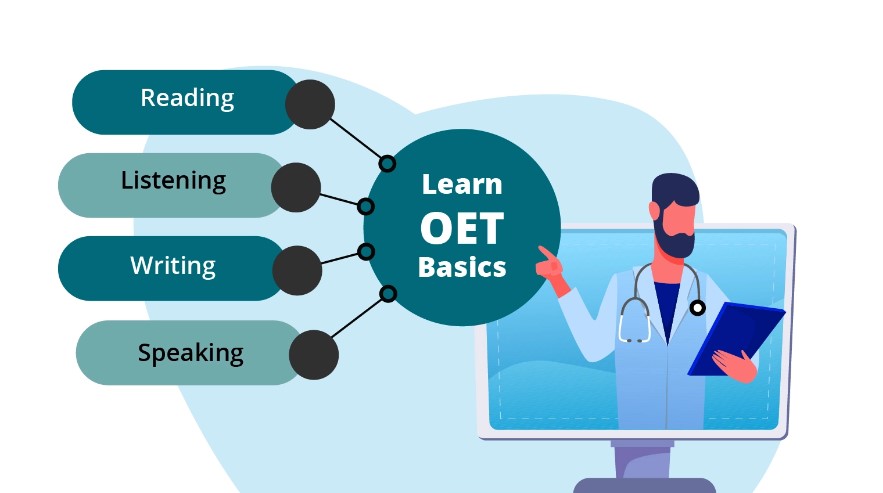
OET Exam focuses on communication in healthcare environments and includes all four language skills
- Listening
- Reading
- Writing
- Speaking
Listening:
OET Listening consists of 3 parts (A, B, and C) and a total of 42 question. You’ll listen to a recorded speech with pauses during each part of the test, giving you time to write your answers.
Duration: 40 minutes
Part A – Consultation extracts (about 5 minutes each): Assesses your ability to recognize specific information during a consultation. You will listen to two recorded health professional-patient consultations and use the information you hear to complete the health professional’s notes.
Part B – Short workplace extracts (about 5 minute each): Assesses your ability to recognize the detail, substance, perspective, or purpose of brief excerpts from the healthcare workplace. You will listen to six audio extracts and complete one multiple-choice question for each.
Part C – Presentation extracts (about 5 minutes each): Assesses your ability to listen to and understand a recorded presentation or interview on a variety of accessible healthcare subjects. You will listen to two different extracts and answer six multiple-choice questions about each one. Two presentations, two interviews, or one of each are possible.
Reading:
OET Reading consists of 3 parts (A, B, and C) and a total of 42 question covering topic of generic healthcare interest
Duration: 60 minutes
Part A – Expeditious reading task (15 minutes): Assesses your ability to quickly and efficiently discover specific information from four short texts. The four brief chapters each cover a different aspect of healthcare, and you must answer 20 questions in the allotted time. Matching, sentence completion, and short answer questions make up the 20 questions.
Part B and Part C – Careful reading tasks (45 minutes):
Part B – Assesses your ability to recognize the detail, gist, or major point of six short texts (100-150 words each) derived from the healthcare workplace. Extracts from policy documents, hospital rules, manuals, or internal communications such as emails or memos could be included in the texts. There is one three-option multiple-choice question for each text.
Part C – Assesses your ability to detect detailed meaning and opinion in two texts (800 words each) on issues of importance to healthcare professionals. You must answer eight four-option multiple choice questions for each text.
Writing:
OET Writing sub-test is a profession – specific. Based on a normal workplace setting and the demands of the profession, one task is assigned to each profession – a nurse does the task for nursing, a dentist does the task for dentistry, and so on.
Duration: 45 minutes
The task is usually to write a letter of referral, this can occasionally be a letter of discharge. Along with the task instructions, stimulus material (i.e. case note) will be provided to you to assist you with the context of the letter.
The OET Writing sub-test is scored based on six criteria:
- Purpose
- Content
- Conciseness & Clarity
- Genre & Style
- Organization & Layout
- Language
Speaking:
OET Speaking sub-test will be given individually; you will be examined on your ability to effectively communicate in a profession-specific role-play scenario (for example, as a nurse or a pharmacist); in each role-play, you will play your professional role while the interlocutor plays a patient, client, or a patient’s relative or caretaker.
Duration: 45 minutes
The OET Speaking sub-test structure
The interlocutor checks your identity and profession throughout each Speaking test, and there is a brief warm-up talk about your professional background. The role plays are then introduced one at a time, with three minutes to prepare for each. Each role play lasts roughly five minutes.
Role plays:
You receive information for each role play on a card that you hold while you play it. The card describes the scenario and what you must do. If you like, you can make notes on the card. During the preparation period, you can ask any questions you have about the role play’s content or how it operates.
The role plays are based on typical working scenarios and represent the expectations placed on a health professional in certain scenarios. The interlocutor follows a script to ensure that the format of the Speaking test is consistent for each candidate. In addition, the interlocutor has specific information to use in each role play. At the same exam administration, different role plays are used for different candidates.
The following criteria are used to score this sub-test:
Linguistics Criteria
- Intelligibility
- Fluency
- Appropriateness of Language
- Resources of Grammar & Expression
Clinical Communication Criteria
- Relationship development
- Understanding and embracing the patient’s point of view
- Providing structure Information-gathering
- Information-giving
Demo Class
Before enrolling in PTE regular classes, you can take a Demo class to clear your mind and ask questions about the OET test.
Our Labs:
At Aura Consultant, we have state-of-the-art audio-visual equipment to provide you with a chance to practice in the real exam environment. Mock exams are conducted to boost your confidence, to check your preparedness, and to achieve the required band score.
